
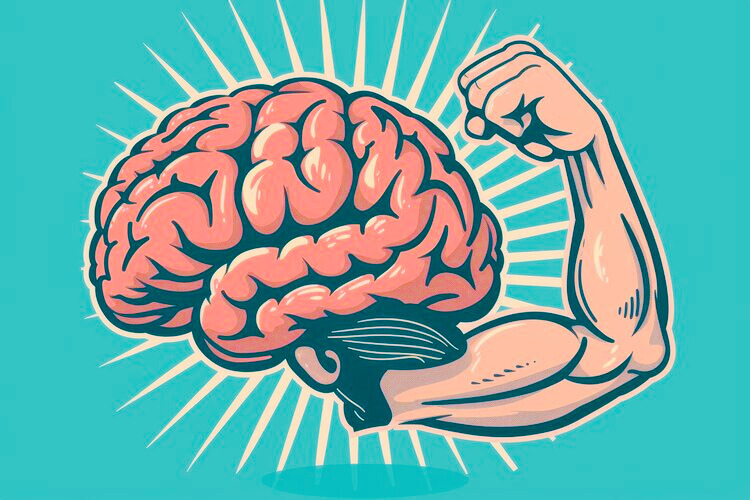
 Most people know by now that the brain continues to change throughout life. This ability—known as neuroplasticity—was confirmed in the 1970s, and since then science has revealed just how specific, adaptive, and experience-dependent these changes are. What’s even more striking is how much influence each of us has over the direction of those changes, for better or for worse.
One of the more surprising discoveries in recent neuroscience is that a particular brain structure, the anterior mid-cingulate cortex (aMCC), grows when a person pushes themselves to do things they genuinely do not want to do and shrinks when they avoid them. Stanford neuroscientist, Andrew Huberman has called this finding “one of the most important discoveries in the history of neuroscience,” which is a bold claim in a field full of breakthroughs in the last decades.
But the aMCC is unique. It sits at the intersection of motivation, conflict monitoring, emotional endurance, and behavioral follow-through. In other words, it reflects our intentional human capacity to move toward and through discomfort rather than away from it. Some researchers have even suggested it contributes to the deeper instinct we think of as “the will to live.”
The idea is simple, but the implications are profound:
Every time you confront real resistance—physical, emotional, or psychological—your aMCC strengthens. When you avoid difficulty, it weakens.
This isn’t just a metaphor. It’s measurable. And it’s how you can strenthen your resilience and mental health.
The Science Behind Building Mental Strength
Several imaging studies have shown that the aMCC is smaller in individuals who struggle with behavioral persistence. In neuroscience, behavioral persistence is continuing an action despite resistance, discomfort, boredom, or obstacles. For example:
People with high behavioral persistence:
-
Stick with goals longer
-
Push through discomfort
-
Follow through on commitments
-
Tolerate frustration better
-
Show grit and resilience
People with low behavioral persistence may:
-
Quit early when something becomes hard
-
Avoid discomfort or challenge
-
Have trouble sustaining lifestyle changes
-
Struggle with motivation, follow-through, or self-regulation

In research, obese people tend to show reduced aMCC volume. However, when they commit to sustained lifestyle changes, like dieting, this part of their brains begin to grow. Elite athletes, on the other hand, have been shown to have unusually large and active aMCC regions, which makes sense given their continuous exposure to discomfort, fatigue, and self-imposed pressure to train hard and keep going — even when they might not want to.
Scientists studying longevity have found that people who live the longest often maintain robust structural integrity in this area of the brain. The aMCC helps regulate effort, pain tolerance, emotional resilience, and the ability to stay engaged when something is difficult or unpleasant. These capacities matter enormously across a lifetime and influence mental health, and physical health. They determine how we adapt to the inevitable challenges of being human.
Huberman emphasizes an especially interesting point: the aMCC grows only when the task is truly difficult for you. If you love taking a cold plunge, your aMCC won’t grow from plunging. However, if you dread cold water (like me!) but get in anyway, it will increase in size. The growth stops the moment a task becomes enjoyable or automatic. It’s the discomfort, not the behavior itself, that is the stimulus for change.
This aligns with a major theme in neuroplasticity research: the brain changes most when it encounters novelty, uncertainty, and emotional friction. Comfort is not a growth state. Challenge and discomfort are.
Avoidance and the Shrinking Brain
On the flip side, avoidance weakens the very circuitry you need to navigate life effectively. Anyone living with chronic anxiety, depression, trauma, or executive dysfunction knows the cycle: something feels overwhelming, you avoid it, and it becomes even harder to approach later. This is more than a psychological loop, It is a neurobiological one.
Avoidance reduces the strength of the aMCC and other prefrontal regions involved in regulation and decision-making. As those circuits weaken, your ability to act in the face of challenge and discomfort erodes. You feel less capable, less resilient, and more easily thrown off course. ButYou don’t avoid situations because you are weak. You avoid them because the circuits that support forward movement have been underused.
The good news is that neuroplasticity works both ways — good and bad. It is what allows the aMCC to shrink, but it is also what allows it to grow. Science shows that when you begin to take even tiny steps toward discomfort, challenging yourself, and working through hardship, the aMCC responds and changes almost immediately. Your brain starts to relearn that it can tolerate the things it once feared or resisted and overcome. This is the same biological mechanism behind exposure therapy, emotional processing, habit change, and behavioral activation. The aMCC is why those approaches work.
I think this is resilience and mental strength in action. Every time you stretch yourself, step outside your comfort zone, or attempt something that feels difficult—even if you don’t succeed right away—you strengthen the neural circuits that support persistence, emotional regulation, and adaptability. Over time, these small acts of courage accumulate, making you mentally and emotionally more resilient to life’s hurdles. I’ve certainly seen this happen in my own life.

Training the aMCC in Everyday Life
You don’t need extreme challenges to strengthen your aMCC. You only need to do something you genuinely don’t want to do, and have the willingness to do it. Your brain doesn’t care whether the friction comes from taking a cold shower, writing a difficult email, initiating an uncomfortable conversation, going for a walk when you’d rather stay planted on the couch watching Netflix, or feeling your emotions instead of suppressing or distracting yourself from them. What matters is the internal experience of resistance and making the conscious choice to move through it.
Growing this part of your brain is less about big, dramatic feats and more about consistency.
-
Do the uncomfortable thing once → the aMCC responds.
-
Do it again → the response strengthens.
-
Do it daily → the circuitry stabilizes and becomes part of who you are.
This is one reason small changes in behaviors can often create disproportionatly large and positive psychological shifts. The shifts act as the neural building blocks of resilience and mental strength. In many ways, this is the “use it or lose it” principle applied to willpower and emotional endurance.
Why This Discovery Matters for Mental and Emotional Health
Understanding the aMCC gives us a deeper appreciation of why change feels so hard and why it is still possible. You are not failing because you lack discipline or character. Your brain may simply be undertrained in the circuitry required for difficult action. But, you can change that and it requires changing your brain.
Likewise, every moment of courage—no matter how small or trivial it may seem—is not just symbolic. It is biological and growing your brain. You are sculpting the mental system that supports persistence, resilience, and the capacity to tolerate discomfort without shutting down. You are building strength.
This is the essence of intentional neuroplasticity. Every uncomfortable choice is a vote for the person you want to become.
Growth Happens One Step at a Time
You don’t need a dramatic transformation or a life-altering challenge to change your brain.
Your aMCC doesn’t grow because you take extreme actions. It grows because you consistently choose to lean into small moments of resistance. Each day offers at least one opportunity to do something you’d rather avoid: a task you’ve been putting off, a conversation you don’t want to have, a workout you don’t feel like doing, a feeling you’d rather not confront. When you move toward that discomfort, even briefly, you send a powerful signal to your brain that you are capable of meeting challenge rather than retreating from it.
Those tiny decisions, repeated over time, are what strengthen the neural circuits of resilience and mental endurance. They accumulate. They compound. And they gradually reshape your sense of who you are and what you can handle.
Growth doesn’t come from chasing extremes; it comes from meeting yourself at the edge of your comfort zone and taking one step further. That’s where your brain changes—and where resilience is built.
Share this article!

1 Comment
This is fascinating. It’s just what I need to know right now as I had a challenging day last week in the ER and I have more challenges ahead to address my medical issues.